Online Review Sites: How Much Do They Really Influence Your Decisions?
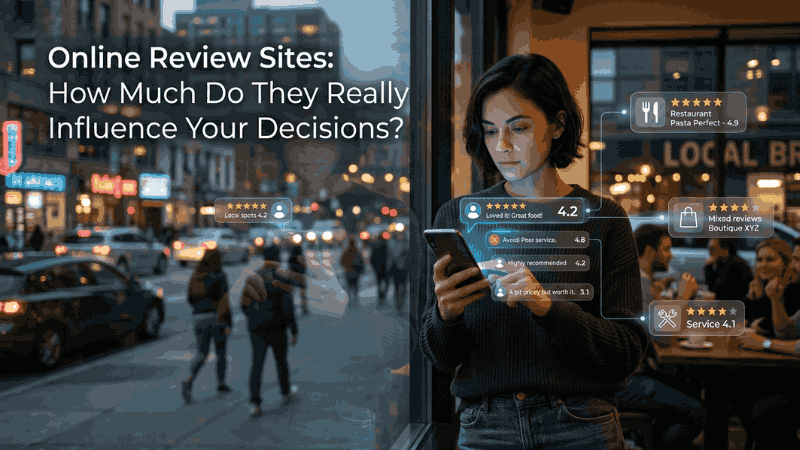
Have you ever picked a product, restaurant, or service just because of what others said online? Or hesitated after reading a few bad experiences? If so, you’re already relying on one of the most powerful decision-making tools in the digital world today.
Online reviews help consumers judge trust, quality, and value before making a decision, while businesses use them to build credibility, improve services, and attract more customers.
What Are Online Review Sites?
Online review sites are platforms where users share their experiences about products, services, or businesses. These reviews usually include ratings, written feedback, and sometimes photos or videos. They act as a bridge between customers and businesses, offering transparency and helping people make informed decisions. For consumers, they simplify the buying process by providing real-world insights, while for businesses, they serve as a powerful tool for reputation management and visibility.
Why Do Online Reviews Matter So Much?

Online reviews play a crucial role in building trust because people tend to believe other customers more than advertisements. When a business has consistent positive feedback, it naturally appears more reliable and credible. Reviews also strongly influence buying decisions, as most users check feedback before making a purchase, and even a slight difference in ratings can affect their choice.
Types of Online Review Platforms
There are several types of review platforms, each serving a different purpose. General review platforms, often referred to as online review sites, cover a wide range of industries and allow users to review almost any type of business. These platforms are widely used and frequently appear in search results, making them highly influential in shaping customer decisions.
E-commerce platforms focus specifically on product reviews, where customers share their experiences after purchasing items. These reviews are often detailed and help other buyers understand product quality, usability, and value for money. Industry-specific platforms cater to niche sectors such as travel, hospitality, or employment, offering more specialized and relevant insights. Social media platforms also function as review spaces, where users share opinions through comments, recommendations, and posts, blending feedback with engagement.
How Consumers Should Use Reviews Smartly
To make the most of reviews, consumers need to look beyond just star ratings and focus on the actual experiences shared by others. A high rating alone does not always guarantee quality, so reading detailed reviews provides better context. It is also important to check consistency in feedback. When multiple users mention the same issue or highlight the same strength, it becomes more reliable information.
Consumers should also stay cautious about fake reviews. Overly promotional language, repeated patterns, or vague comments can be warning signs. Paying attention to recent reviews is equally important, as businesses can change over time, and the latest feedback often reflects the current reality more accurately.
How Businesses Can Leverage Reviews for Growth

For businesses, reviews are not just feedback but a powerful growth strategy. Encouraging genuine reviews from satisfied customers helps build a strong and trustworthy online presence. Timing plays an important role, as customers are more likely to leave feedback immediately after a positive experience.
Responding to reviews is equally essential. A thoughtful response to positive feedback shows appreciation, while addressing negative reviews professionally demonstrates accountability and a willingness to improve. Businesses can also use reviews as part of their marketing strategy by showcasing customer testimonials on websites, social media, and promotional campaigns.
Moreover, reviews provide insights that can drive improvement. Negative feedback, when analyzed properly, can highlight recurring issues and offer opportunities to enhance products or services, ultimately leading to better customer satisfaction.
Common Mistakes to Avoid
Many consumers make the mistake of relying solely on ratings without reading the actual content of reviews, which can lead to poor decisions. Ignoring negative reviews entirely is another common issue, as they often contain valuable insights. Some even consider shortcuts like “purchase Google reviews,” but this can distort reality and reduce trust. Depending on only one platform can also limit perspective, so checking multiple sources is a smarter approach.
On the business side, ignoring feedback, especially negative comments can harm credibility. Posting fake reviews may seem like a shortcut but often backfires by damaging trust. Being defensive in responses can also create a negative impression, whereas a calm and professional approach builds respect and confidence.
The Future of Review Platforms

The future of online reviews is evolving with technology. Artificial intelligence is being used to analyze customer sentiment and detect patterns, making reviews more meaningful and reliable. Video reviews are becoming more popular, offering a more authentic and engaging way to share experiences.
Platforms are also introducing verified buyer systems to reduce fake reviews and increase trust. Personalization is another growing trend, where users receive recommendations based on their preferences and past behavior, making the review experience more relevant and efficient.
Conclusion
Online review sites have completely changed how people make decisions in the digital age. They provide transparency, build trust, and create a space where customers and businesses can interact openly. For consumers, they simplify choices and reduce uncertainty, while for businesses, they open doors to growth, improvement, and stronger customer relationships often supported by top online reputation management companies that help brands monitor, respond to, and optimize their reviews effectively.
FAQs
1. Can online reviews be trusted?
Online reviews can generally be trusted when users focus on patterns, detailed feedback, and recent experiences rather than relying only on ratings.
2. How many reviews are enough to trust a business?
There is no fixed number, but consistency across multiple reviews is more important than the total count.
3. Do negative reviews hurt businesses?
Negative reviews do not always harm businesses; in fact, they can increase credibility when handled professionally.


Comments